
RotaSmart blog
What wage percentage should a small pub target?
Understand useful wage percentage benchmarks for small pubs, how to calculate labour cost properly and how to keep rota cost under control before the week goes live.

Operational insight
The useful moment is before publish, when managers can still move hours, protect peaks, and keep wage percentage under control.
Operator checklist
- Set expected sales for the week.
- Check planned labour cost before publishing.
- Review quiet-period cover separately from peak cover.
- Record the reason for any planned overspend.
Quick answer
A small pub should set a wage percentage target that fits its trading style, then review planned labour against forecast sales before publishing the rota.
Key takeaways
- Wage percentage is planned labour cost divided by sales.
- Benchmarks depend on the type of pub: wet-led, food-led, event-led or mixed.
- A weekly target is useful, but quiet days and busy days will behave differently.
- Wage percentage should be checked during rota build, not only after payroll or sign-off.
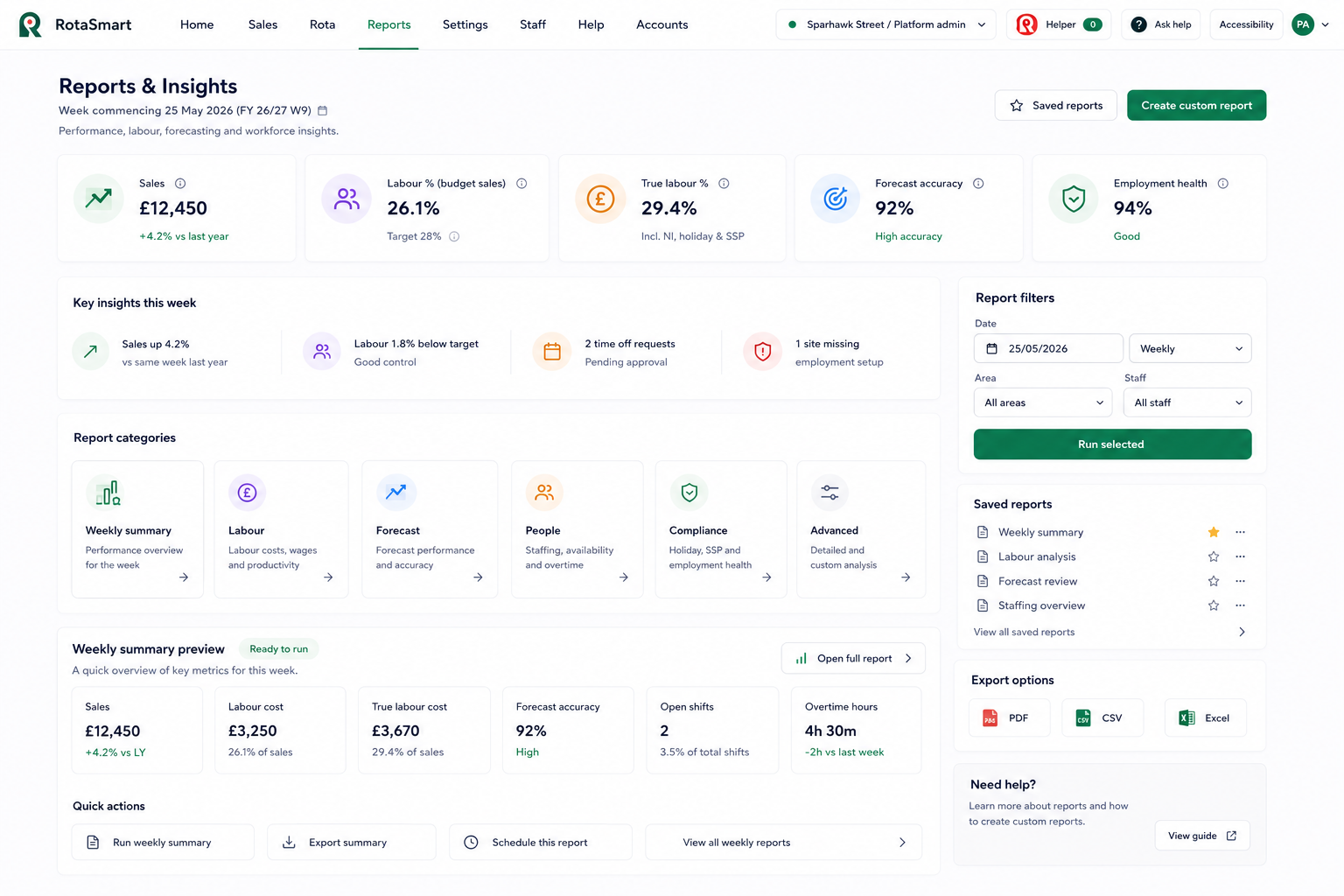
- RotaSmart keeps forecast sales, planned labour and wage percentage in one view.
Labour is one of the biggest controllable costs in a pub. If you cannot see wage percentage until the week has ended, you are managing overspend after it has already happened.
The better approach is to set a sensible target, forecast the week, build the rota, and check wage percentage while the shifts can still be changed.
1. Start with a realistic benchmark
There is no single wage percentage that fits every pub.
As a planning guide:
- Wet-led pubs often aim for a lower labour percentage because service is simpler.
- Food-led pubs usually need more kitchen, floor and prep labour.
- Community pubs with events can move above or below target depending on the trading week.
- Small teams may see higher percentages on quiet days because minimum cover is still needed.
For many small pubs, a weekly wage percentage target somewhere around the mid-20s to low-30s can be a useful starting point, but your actual target should reflect your venue, sales mix, staffing model and owner or pub-company expectations.
RotaSmart's wage percentage guide explains the calculation in more detail.
VAT pressure is another reason to keep this number visible. What #VATsTheProblem means for hospitality labour planning explains why pricing, margin and rota cost need to be reviewed together.
2. Calculate wage percentage correctly
The basic formula is:
Wage percentage = total labour cost divided by total sales.
For rota planning, use the labour cost that reflects your operating view. That may include hourly pay, salaried staff allocation, employer costs and paid time where your business tracks them.
Example:
Planned labour cost: £3,265; Forecast sales: £13,250; Wage percentage: 24.6%.
The point is not just to calculate the number. The point is to see it while you can still change the rota.
RotaSmart's labour cost calculator can help size the relationship between sales, labour and wage percentage.
3. Budget by day, not just by week
A weekly wage percentage can hide the real issue.
Friday and Saturday may run comfortably because sales are high. Monday afternoon may look expensive because the pub still needs minimum cover even when trade is quiet. That does not automatically mean Monday is wrong. It means the rota needs to be judged against the demand and purpose of each day.
Use daily forecasts to decide:
Where the week needs more cover; Where the rota can be leaner; Where prep, cleaning and stock work should sit; Whether quiet periods are still productive.
The sales forecasting view helps managers build daily and hourly sales expectations before they commit to labour.
4. Flex staffing without weakening service
The fastest way to damage service is to cut peak cover just to hit a percentage. The better approach is to remove waste from the wrong hours.
Review:
Quiet afternoons with too much floor cover; Late finishes that are longer than needed; Staff scheduled before trade starts; Untracked breaks or early clock-ins; Repeated copy-forward shifts that no longer match demand.
Then adjust shift lengths, start times and role mix. Multi-skilled staff can help cover more than one area, but only if the rota still protects the sessions that need specialist cover.
RotaSmart's labour forecasting and rota builder keep demand, cost and cover visible together.
5. Review monthly, but act weekly
Monthly reporting is useful, but waiting a month to fix labour drift is too slow.
A strong routine is:
Forecast the coming week; Build the rota against that forecast; Check wage percentage before publishing; Review actual sales and labour after the week; Adjust the next rota based on what changed.
The scheduled staff cost review can help review planned labour, while shift sign-off and clocking data help show what actually happened.
6. Treat low wage percentage with care
A low wage percentage is not always good. It can mean the pub is efficient, but it can also mean service is stretched, managers are covering unpaid gaps, or staff are missing breaks.
If wage percentage looks unusually low, check:
Guest complaints; Queue times; Staff fatigue; Unfilled shifts; Manager overtime; Missed prep or cleaning tasks.
Labour control is about sustainable cover, not just the lowest possible number.
Want to see this on your own week?
Walk through forecast, rota build, labour cost, wage percentage, and staff app flow with RotaSmart.