
RotaSmart blog
Why Friday sales forecasts distort pub labour costs
Learn why weekly averages can mislead pub labour planning and how day-by-day sales forecasting keeps wage percentage and rota cover under control.

Operational insight
The useful moment is before publish, when managers can still move hours, protect peaks, and keep wage percentage under control.
Operator checklist
- Set expected sales for the week.
- Check planned labour cost before publishing.
- Review quiet-period cover separately from peak cover.
- Record the reason for any planned overspend.
Quick answer
Friday sales can hide quiet-day overspend and peak under-cover, so pubs should forecast by day and hour before building the rota.
Key takeaways
- Weekly averages hide day-by-day trading patterns.
- Friday and Saturday should be forecast separately from quieter midweek sessions.
- Wage percentage can be higher on quiet days and lower on busy days, as long as the weekly plan makes sense.
- Hourly forecasting helps place labour where demand actually lands.
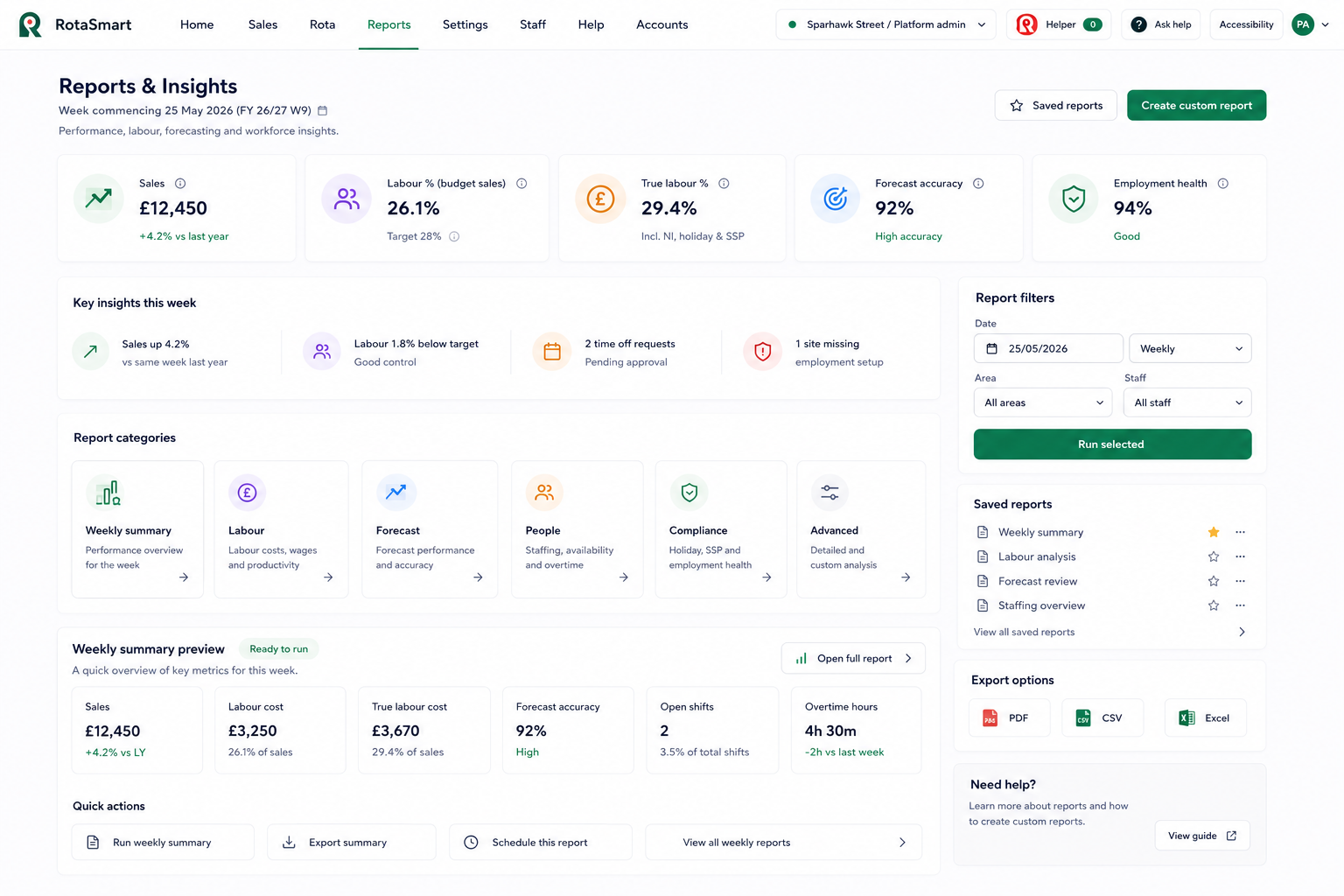
- RotaSmart connects sales forecasting to rota cost before the week goes live.
A strong Friday can make the weekly forecast look healthy while the rota is still wrong.
If a pub plans labour from a weekly average, it can overstaff quieter days and under-cover the sessions that actually drive trade. Friday evening and Saturday may carry the week, while Monday to Wednesday need a very different labour shape.
1. Weekly averages are too blunt
Imagine a pub forecasts £14,000 for the week. That number is useful, but it does not tell the manager where the sales will happen.
If Friday and Saturday make up a large share of weekly sales, a flat labour plan will mislead the rota. You may have too many staff on a quiet Tuesday and not enough cover on Friday evening.
The sales forecasting view helps break the week down by day and trading hour, so staffing follows demand rather than an average.
2. Plan each day separately
Each day has its own role.
For a pub, that might mean:
Monday: low cover, prep and recovery tasks; Tuesday and Wednesday: lean service cover; Thursday: stronger evening trade; Friday: after-work and late trading pressure; Saturday: lunch, evening and close-down cover; Sunday: food, family trade or bank holiday lead-in demand.
Once you forecast each day separately, wage percentage starts to make more sense. A quiet Monday may carry a higher wage percentage because the pub still needs minimum cover. A busy Friday may carry a lower percentage because sales are stronger.
3. Forecast by hour, not just by day
Even daily forecasts can be too broad.
A Friday may be quiet at midday and very busy from 6pm. If the rota gives the same cover all day, labour cost drifts before the peak and service suffers during the rush.
Use hourly planning to decide:
- When extra bar cover starts.
- When kitchen or floor cover needs overlap.
- Whether late close needs a separate shift.
- When staff can move to prep, cleaning or stock tasks.
RotaSmart's labour forecasting helps turn expected trade into staffing demand, while the rota builder lets managers adjust shifts while cost and cover are still visible.
4. Avoid copying last Friday
Copying last week can be useful as a starting point, but it is risky when the reason for trade has changed.
Last Friday may have had:
Live sport; Good weather; A local event; A payday pattern; A private booking; Staff sickness that hid the real rota requirement.
If this week does not have the same trading context, the rota should change.
RotaSmart's week trade review and forecasting workflow are designed to help managers check what is different before the rota is built.
5. Review actuals after the week
Forecasting improves when managers review the result.
After the week, compare:
Forecast sales vs actual sales; Planned labour vs actual labour; Wage percentage by day; Open shifts and cover gaps; Staff clock-in and sign-off exceptions.
This creates a practical feedback loop. The next Friday forecast should be based on what actually happened, not just what was planned.
6. Keep the weekly target, but manage the day shape
Weekly wage percentage is still important. It tells managers whether the rota is commercially sensible overall.
But the daily shape is what makes the rota work. A pub can hit the weekly target and still have poor service if labour is in the wrong place.
The best routine is:
Forecast sales by day and hour; Build the rota around the demand shape; Check wage percentage before publishing; Review actuals and improve next week's forecast.
Want to see this on your own week?
Walk through forecast, rota build, labour cost, wage percentage, and staff app flow with RotaSmart.