
RotaSmart blog
Why tracking labour cost matters and how RotaSmart keeps it in view
Why hospitality labour cost, wage percentage and budget variance need to be visible before the rota goes live.

Operational insight
The useful moment is before publish, when managers can still move hours, protect peaks, and keep wage percentage under control.
Operator checklist
- Set expected sales for the week.
- Check planned labour cost before publishing.
- Review quiet-period cover separately from peak cover.
- Record the reason for any planned overspend.
Quick answer
Labour cost needs to be visible while the rota is still editable, so managers can adjust shifts before wage percentage and payroll spend drift.
Key takeaways
- Understand your labour budget and wage percentage
- Connect commercial targets to rota cost
- Keep labour cost, wage percentage and variance visible
- Use early checks and fairness indicators
- Turn insight into action
Labour costs are among the biggest expenses in hospitality. If you cannot see them until after the week has ended, it is almost impossible to control them.
RotaSmart puts wage percentage and labour budgets front and centre during the planning process, so you can make informed decisions before the rota goes live. Here is how to think about labour cost and why RotaSmart helps you manage it.
1. Understand your labour budget and wage percentage
In simple terms, your labour budget is how much you plan to spend on staff for a given week, and your wage percentage is that spend expressed as a percentage of sales.
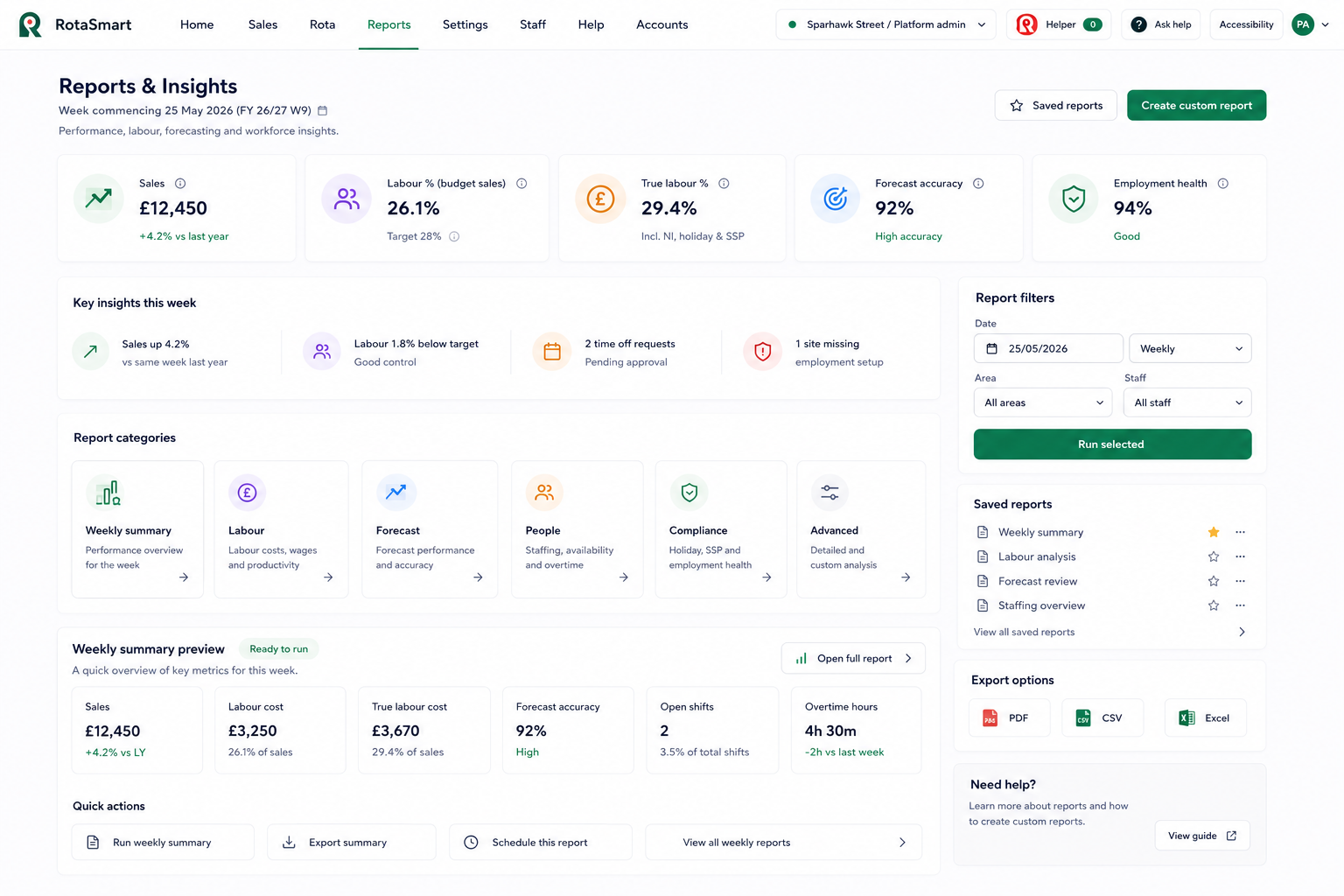
Keeping your wage percentage within a healthy range helps protect profit. RotaSmart's labour cost control view shows forecast sales, labour budget, wage percentage and variance together. This allows owners and managers to see if they are on track or overspending before shifts are assigned.
2. Connect commercial targets to rota cost
RotaSmart's weekly planning hub connects your commercial target with rota cost and demand cover. You can model savings, then check the live rota decision to make sure your labour budget stays aligned with your sales forecast.
By forecasting the week before you build the rota, you see the commercial shape of the week and can make adjustments before wage percentage drifts. The wage percentage guide explains the calculation and why it matters during planning.
3. Keep labour cost, wage percentage and variance visible
Throughout scheduling, RotaSmart keeps rota cost, wage percentage and budget variance visible. Seeing these metrics early makes it easier to decide whether to add or reduce shifts, redistribute hours or reallocate staff to busier dayparts.
When labour cost and cover stay in view, managers avoid last-minute surprises and make better decisions while the rota can still change.
4. Use early checks and fairness indicators
Beyond cost, strong rotas consider fairness and fatigue. RotaSmart prompts managers to check not just cost, but also fairness and fatigue before publishing.
This helps ensure that staff are scheduled evenly, that the same people are not repeatedly working late closes or double shifts, and that your rota supports employee wellbeing.
5. Turn insight into action
Once you have a clear view of labour cost and wage percentage, you can take steps to control them. For example, align staffing levels to demand patterns, cross-train team members so they can cover multiple roles, and schedule breaks during naturally quiet periods.
RotaSmart's tools make these strategies easier because you can see how each change affects cost and cover in real time. If something changes mid-week, the RotaSmart Team app lets staff request swaps or time off while keeping managers informed.
6. Make labour cost control part of the routine
Controlling labour cost is not a one-off exercise. It is part of your weekly routine. With RotaSmart, you forecast demand, build the rota, check costs and fairness, and manage changes while wage percentage and budget variance stay in view.
The result is a more predictable wage bill, happier staff and better margins. For more detail, read what wage percentage a small pub should target and how to reduce hospitality labour cost without cutting peak cover.
Try RotaSmart's labour cost calculator, review payroll reporting, or book a demo to see how your venue could benefit from smarter labour planning.
Want to see this on your own week?
Walk through forecast, rota build, labour cost, wage percentage, and staff app flow with RotaSmart.